
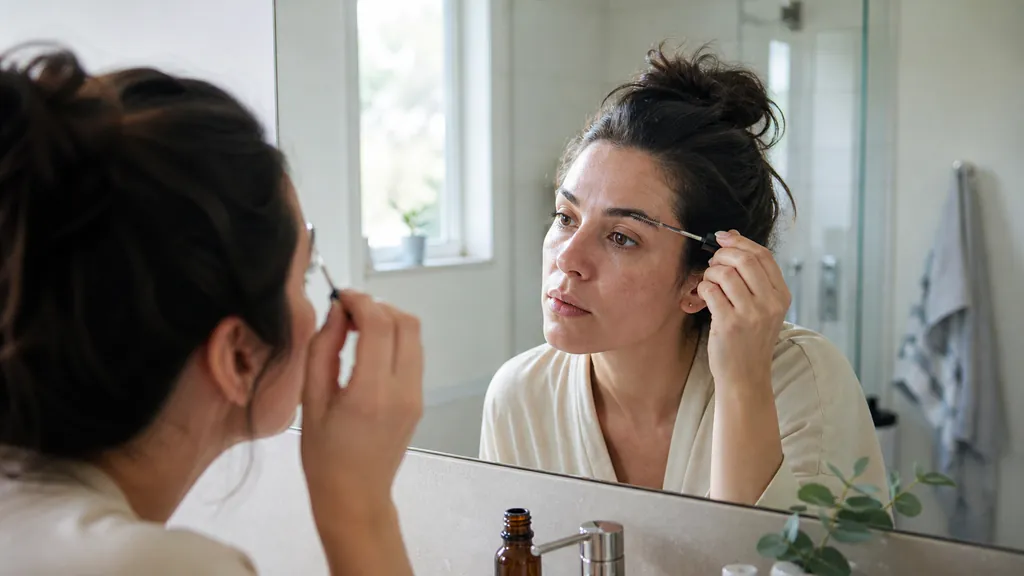
Brows did not get the memo that hair serums are supposed to stay on the scalp. Now a small human trial has tested copper peptide directly where sparse brows matter.
A 2026 randomized trial found that a 2% topical GHK-Cu serum improved eyebrow hair count and thickness after 12 weeks compared with placebo. The study was small, but it gives copper-peptide beauty brands a much more useful story than a viral before-and-after post.
Did copper peptide help eyebrows?
Yes, a small split-face trial found a measurable benefit at 12 weeks.
Formula tested
A topical serum described as 2% GHK-Cu.
What improved
Eyebrow hair count, hair diameter, photos and satisfaction.
Study size
18 healthy adults over 12 weeks.
What did the 2026 GHK-Cu eyebrow study do?
Researchers enrolled 18 healthy adults between ages 18 and 40. Each person used the 2% GHK-Cu serum on one eyebrow and a matching vehicle serum on the other. The assigned side was random, and both the participants and evaluators were blinded.
That split-face design is useful because every participant acts as their own comparison. Genetics, sleep, diet and normal hair-growth speed are more balanced than they would be between two completely separate groups.
Participants applied the products twice a day for 12 weeks. Researchers measured:
- eyebrow hair count;
- hair diameter;
- standardized photographs;
- investigator appearance scores;
- participant satisfaction; and
- adverse effects.
The GHK-Cu side showed significant improvement in hair count and diameter, especially at week 12. Photo scores and satisfaction were also higher on the treated side. The study reported no serious adverse effects or allergic reactions.
What does “2% copper peptide” mean?
In this study, the authors described the tested product as a 2% GHK-Cu serum. That number is useful, but a commercial percentage still needs a definition.
A label or supplier quote might refer to:
- 2% pure GHK-Cu active;
- 2% of a diluted supplier solution;
- 2% of a named copper-peptide complex; or
- 2% of a blend that contains more than one ingredient.
Those are not automatically equal. A beauty brand should ask the formulator to write the percentage basis into the formula brief and supporting file.
The ingredient name should also stay consistent. GHK-Cu is commonly listed as Copper Tripeptide-1 on a cosmetic ingredient list. AHK-Cu is another copper peptide, but it is a different molecule. Our GHK-Cu vs AHK-Cu guide explains the practical difference.
Is the eyebrow result believable?
It fits the wider copper-peptide hair story.
Earlier laboratory research found that AHK-Cu helped isolated human hair follicles grow longer and supported dermal papilla cells at the base of the follicle. Other human studies have reported positive hair-count or hair-fall signals from formulas that included GHK or Copper Tripeptide-1.
The new eyebrow trial is cleaner for one specific question because it tested a GHK-Cu serum against its vehicle on opposite sides of the same face.
It is still an early result. Eighteen people cannot answer every question about different ages, skin types, causes of sparse brows or long-term use. But the study does provide a direct human signal for a search query consumers are already asking: can copper peptides help eyebrows?
For the scalp version of the question, see our guide to copper peptides for hair growth.
How long did the eyebrow serum take to work?
The clearest result appeared at 12 weeks. That is a useful expectation check.
Hair grows in cycles. A product that supports the environment around the follicle still needs time before a change becomes visible. Days are too soon to judge an eyebrow-density product.
A sensible consumer test would keep the rest of the routine steady and take one photo every few weeks in the same light, at the same angle and before trimming or filling the brows. That makes a gradual change easier to see.
What the study does not compare
The trial compared GHK-Cu with a matching vehicle. It did not compare the serum head-to-head with minoxidil, bimatoprost, a prostaglandin analog, a brow conditioner or a cosmetic tattoo.
That means the direct claim is simple: the tested GHK-Cu serum beat its vehicle in this small study. It does not create a winner across every eyebrow product category.
For a beauty brand, this is still valuable. A focused, supportable ingredient story usually converts better than a giant claim the evidence cannot defend.
What should shoppers look for in an eyebrow serum?
The front label may say “copper peptide complex.” The ingredient list and product details should make the idea clearer.
Look for:
- A named copper peptide. GHK-Cu usually appears as Copper Tripeptide-1.
- A clear application format. A narrow brush or spoolie can make brow use easier and reduce waste.
- A realistic timeline. The new study measured the clearest result at 12 weeks, not overnight.
- A comfortable full formula. The preservative system, pH, texture and other ingredients matter too.
- No magic language. A real cosmetic product does not need to promise a new eyebrow in three days.
Anyone with sudden or patchy eyebrow loss should speak with a qualified health professional because an underlying condition may need attention.
Why this result matters to beauty brands and OEM buyers
This is a strong content-to-product bridge. The consumer question is easy to understand, the tested format is topical, and the 12-week result can support a credible product-education story.
Before requesting a GHK-Cu eyebrow-serum quote, a brand should lock:
- exact ingredient identity and INCI name;
- active-percentage basis;
- serum texture, color and target pH;
- applicator style and unit size;
- raw-material identity and quality documents;
- pilot, stability, microbiology and package-compatibility plans;
- claim wording and evidence file;
- sample quantity, first-order MOQ and repeat forecast; and
- destination market and target launch date.
The eyebrow area also makes applicator testing important. A package built for a full-face serum may deliver too much product for a small brow line. Test the real formula with the real spoolie, brush, pen or narrow wiper before production.
Our 2026 copper peptide OEM guide covers the formula, testing, packaging and quote decisions in detail. The OEM stability-testing guide explains why the finished formula needs its own evidence beyond the raw-material COA.
What should go in a GHK-Cu eyebrow-serum RFQ?
A useful first message can be short:
- product: leave-on eyebrow serum;
- active: Copper Tripeptide-1 / GHK-Cu;
- concentration target and percentage basis;
- package: brush, spoolie or pen concept;
- unit size and first-order quantity;
- target market;
- required documents and testing;
- fragrance and texture direction; and
- desired sample and launch dates.
If the project starts with the cosmetic active rather than a finished formula, review the GHK-Cu product specification and request the bulk quantity, destination and document needs.
The simple takeaway
A 2% topical GHK-Cu serum improved eyebrow hair count and thickness after 12 weeks in a small 2026 randomized trial. It is an encouraging direct human result for Copper Tripeptide-1 in an eyebrow format.
For consumers, the practical lesson is to look for a named ingredient and judge progress over months. For beauty brands, the opportunity is a simple claim, precise formula brief and well-tested applicator rather than another vague “peptide complex.”
Request GHK-Cu bulk or eyebrow-serum OEM options →
Sources and further reading
- 2026 randomized study: 2% GHK-Cu serum for eyebrow hypotrichosis
- Laboratory study: AHK-Cu and human hair follicles
- Cosmetic Ingredient Review: safety assessment of Tripeptide-1 and related ingredients
This article explains cosmetic and research evidence available through August 17, 2026. It does not diagnose eyebrow loss or provide personal medical advice.
Frequently asked questions
Do copper peptides help eyebrow growth?
A small 2026 randomized split-face trial found that a 2% topical GHK-Cu serum improved eyebrow hair count and thickness after 12 weeks compared with placebo.
How long did copper peptide eyebrow serum take to work?
The clearest improvements in the 2026 study were reported at week 12. Eyebrow hair changes are gradual, so the study supports judging results over months rather than days.
What percentage of GHK-Cu was used for eyebrows?
The study described a 2% GHK-Cu serum. A commercial brand should still state exactly what its percentage means because a supplier solution, peptide complex and pure active are not automatically the same basis.
Is GHK-Cu the same as Copper Tripeptide-1?
Yes. GHK-Cu is commonly listed as Copper Tripeptide-1 on cosmetic ingredient lists and raw-material documents. AHK-Cu is a related but different copper peptide.
Is GHK-Cu better for eyebrows than minoxidil or bimatoprost?
The 2026 study compared GHK-Cu with a matching vehicle, not with minoxidil or bimatoprost. It therefore supports a positive GHK-Cu signal but does not prove superiority to those products.
What should a beauty brand ask a copper peptide OEM?
Ask for the exact ingredient identity, active-percentage basis, raw-material documents, formula pH, stability and microbiology plan, final-package testing, MOQ, lead time and claim-support file.
Educational content only. Cosmetic ingredients and finished products are not interchangeable, and this article does not diagnose or treat hair or skin conditions. Follow the finished-product label and ask a qualified healthcare professional about persistent concerns.
← More skin & hair peptides guides · Have a question? Start an inquiry →