
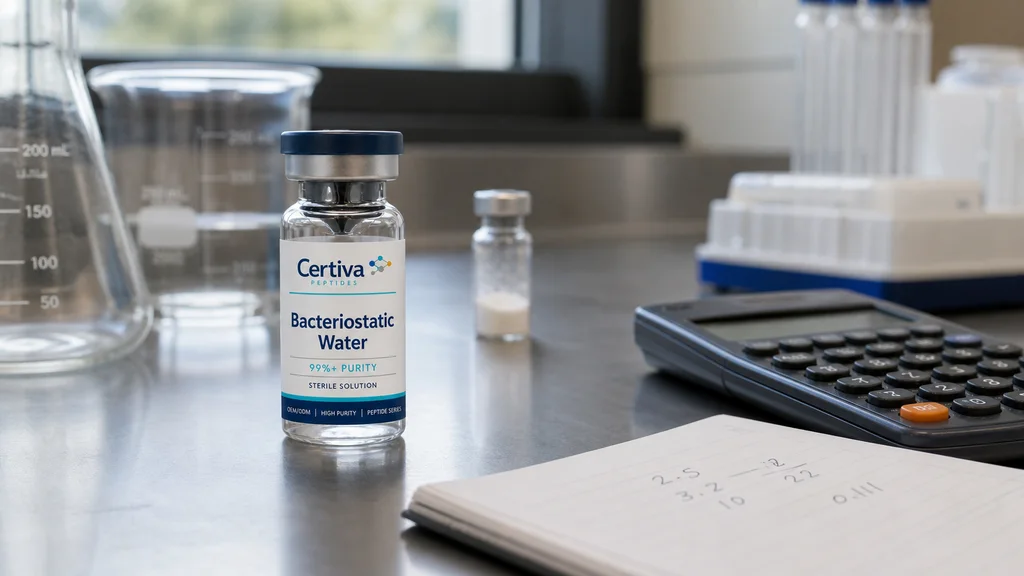
There is no single volume of bacteriostatic water that is correct for every peptide vial. The answer depends on two numbers: the labeled mass in the vial and the target concentration required by the applicable documentation or validated protocol.
Once those numbers are known, the arithmetic is simple:
Required total volume (mL) = vial mass (mg) ÷ target concentration (mg/mL)
For example, a 5 mg vial and a target concentration of 2.5 mg/mL give a total volume of 2 mL. That is a worked unit-conversion example, not a recommendation to use that concentration or diluent.
This distinction matters. A calculator can verify the math, but it cannot tell you which solvent, concentration or protocol is appropriate. Those decisions must come from an approved product label, a validated laboratory method or a licensed clinician, depending on the context.
How to calculate the total liquid volume
Before calculating anything, identify the labeled vial mass, the required target concentration and the specified diluent. Do not infer the last two from the vial mass alone.
The units provide a useful error check. Dividing milligrams by milligrams per milliliter leaves milliliters:
5 mg ÷ 2.5 mg/mL = 2 mL
The same equation works with other values:
| Example calculation | Arithmetic | Total liquid volume |
|---|---|---|
| 5 mg at 5 mg/mL | 5 ÷ 5 | 1 mL |
| 5 mg at 2.5 mg/mL | 5 ÷ 2.5 | 2 mL |
| 10 mg at 5 mg/mL | 10 ÷ 5 | 2 mL |
| 10 mg at 2.5 mg/mL | 10 ÷ 2.5 | 4 mL |
These are arithmetic examples only. They do not establish that any listed concentration is suitable for a particular product, experiment or person.
If you already have an authorized target concentration, Certiva’s peptide calculator can perform the same conversion and display the formula behind the result.
Why there is no universal answer
A label such as “5 mg” describes the total labeled mass in the vial. It does not describe a concentration, because concentration cannot be known until the total liquid volume is known. It also does not identify the correct diluent.
This is why answers copied from a forum, video or different vial can be misleading. A volume that produces one concentration from a 5 mg vial produces a different concentration from a 10 mg vial. Even when the vial mass matches, the required solvent and concentration may not.
For an approved medicine, follow its current prescribing information and the instructions of a licensed healthcare professional. For laboratory work, use the controlled method or protocol for that material. This page is not a reconstitution instruction for human use.
Does adding more water change the amount of peptide?
Adding liquid changes concentration, not the labeled mass already present. A 5 mg vial remains a 5 mg vial after the total liquid volume changes.
| Same labeled 5 mg vial | Resulting concentration |
|---|---|
| 1 mL total volume | 5 mg/mL |
| 2 mL total volume | 2.5 mg/mL |
| 3 mL total volume | 1.67 mg/mL |
More liquid therefore produces a lower concentration; less liquid produces a higher concentration. Neither observation tells you what concentration should be used. It only describes the relationship between mass and volume.
If the total volume is known and you need to check the resulting concentration, reverse the equation:
Concentration (mg/mL) = vial mass (mg) ÷ total volume (mL)
For a 10 mg vial with a total volume of 2 mL, the calculated concentration is 5 mg/mL. To convert milligrams to micrograms, multiply by 1,000; the NIST SI-prefix reference defines “milli” as 10⁻³ and “micro” as 10⁻⁶.
Bacteriostatic water and sterile water are not the same
Bacteriostatic Water for Injection, USP is sterile water containing a bacteriostatic preservative. The DailyMed labeling for one marketed presentation specifies 0.9% benzyl alcohol in a multiple-dose container. Sterile Water for Injection is preservative-free.
The presence or absence of a preservative is a material difference, so the two should not be treated as automatically interchangeable. The word “bacteriostatic” also says nothing about how many milliliters a particular vial requires. The selected material must match the controlling documentation or protocol; the equation only checks the resulting math.
For procurement purposes, Certiva lists Bacteriostatic Water and Sterile Water separately, with specifications and quality documentation available on request.
What the Certiva peptide calculator can—and cannot—do
The Certiva peptide calculator uses values supplied by the visitor to display concentration, volume and a U-100 scale conversion. It runs in the browser and shows the equation used.
It does not choose a peptide, diluent, concentration, amount, frequency, schedule or route of administration. A plausible-looking result can still be wrong if the starting value or unit is wrong. Check whether the vial label uses mg or mcg, confirm that the volume is the final total volume, and keep the units visible until the calculation is complete.
The most reliable rule is therefore short: establish the correct inputs from an authoritative source first, then use mass ÷ target concentration to calculate the total volume.
Sources and further reading
- DailyMed: Bacteriostatic Water for Injection, USP
- NIST: Metric (SI) prefixes
- NIST: SI units of volume
This article explains concentration arithmetic. It is not medical advice and does not provide a preparation, dosing or administration protocol.
Frequently asked questions
How much bacteriostatic water should I add to a peptide vial?
There is no universal volume. First obtain the required concentration and specified diluent from the applicable product documentation, validated laboratory protocol or licensed clinician. For arithmetic only, divide vial mass in mg by target concentration in mg/mL to get total volume in mL.
What is the formula for calculating liquid volume?
Required total volume in mL equals vial mass in mg divided by target concentration in mg/mL. For example, 5 mg divided by 2.5 mg/mL equals 2 mL total volume. This example demonstrates unit conversion and is not a recommended concentration.
Does adding more bacteriostatic water change the amount of peptide?
No. It changes the concentration, not the labeled peptide mass in the vial. The same 5 mg in 1 mL is 5 mg/mL, while 5 mg in 2 mL is 2.5 mg/mL.
Is bacteriostatic water the same as sterile water?
No. Bacteriostatic Water for Injection contains a preservative, commonly 0.9% benzyl alcohol, while Sterile Water for Injection is preservative-free. They should not be treated as automatically interchangeable.
Can the Certiva calculator choose a solvent or concentration?
No. It only performs arithmetic with values entered by the visitor. It does not select a solvent, concentration, amount, schedule or method of administration.
For research use only. Not for human consumption. This article is educational and makes no medical, therapeutic, or dosing claims.
← More peptide basics guides · Have a question? Start an inquiry →