

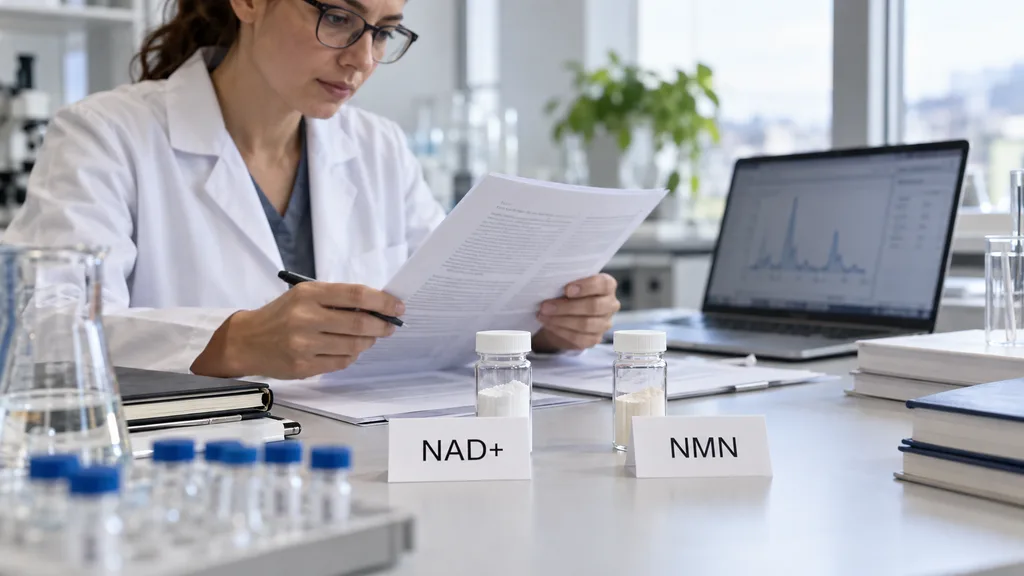
NAD+ vs NMN is a comparison between a coenzyme and one of its precursors. NAD+ is nicotinamide adenine dinucleotide. NMN is nicotinamide mononucleotide, a molecule used in NAD+ biosynthesis. Neither is a peptide.
A new study published in September 2026 adds a useful distinction to the discussion: increasing a blood biomarker and improving a measured function are different outcomes. Knowing which molecule was supplied or studied is the first step toward understanding either result.
NAD+ vs NMN at a glance
| Question | NAD+ | NMN |
|---|---|---|
| Full name | Nicotinamide adenine dinucleotide | Nicotinamide mononucleotide |
| Chemical identity | A dinucleotide coenzyme | A nucleotide precursor |
| Relationship | Participates in cellular reactions | Used in pathways that produce NAD+ |
| Is it a peptide? | No | No |
| Is the name interchangeable? | Not with NMN, NR or NADH | Not with NAD+, NR or NADH |
| Does a study of one automatically validate a product containing the other? | No | No |
The names are related because the molecules participate in connected biology. They are not synonyms, and “NAD booster” does not identify one standardized material or product.
What is NAD+?
EMBL-EBI’s ChEBI entry for NAD+ identifies it as the oxidized form of nicotinamide adenine dinucleotide and describes its role in metabolic redox reactions, carrying electrons between reactions. ChEBI classifies it as a coenzyme and cofactor.
For a laboratory buyer, that identity is useful independently of a longevity headline. The material name should match the scientific question and the supplier documents. A familiar catalog category is less specific than a chemical identity.
NAD+ is often discussed alongside mitochondrial peptides. That does not make it chemically equivalent to them. Our MOTS-c vs SS-31 comparison introduces two peptide identities that should remain distinct from NAD+.
What is NMN, and where does NR fit?
ChEBI identifies nicotinamide mononucleotide as a nucleotide. NMN is discussed in human research as a precursor to NAD+. Nicotinamide riboside, or NR, is another precursor, with a different chemical identity.
This creates several questions that should be kept separate:
- Which starting material was tested?
- Which metabolite was measured?
- Was the result biochemical, functional or a participant’s subjective report?
- Does the proposed commercial product match the intervention in the paper?
A product’s name may foreground NAD+ even when its listed ingredient is a precursor. Check the ingredient and preparation rather than assuming the front label resolves the distinction.
Why is NAD+ being called a peptide online?
Peptide communities discuss many materials beyond amino-acid chains. On October 4, 2026, a Biohacking thread included an explicit clarification that NAD was not a peptide. A September 15 discussion asked how NADH, NMN and NR relate to one another.
Those posts reveal a terminology gap. They do not establish what any intervention does for health. For the chemistry definition of a peptide, see our what are peptides guide.
The same distinction applies to Certiva’s catalog: NAD+ is listed alongside research materials, but the supplier category does not turn a dinucleotide into a peptide.
What did the September 2026 NMN trial find?
The September 25 paper in npj Aging reported a randomized, double-blind, placebo-controlled study of oral NMN over 24 weeks in adults aged 65 or older.
Blood NAD+ and related metabolites increased. The primary hearing endpoint and physical performance measures did not show significant improvement. Other nominal changes did not remain significant after adjustment for multiple testing, so the authors treated them as exploratory.
This supports a biochemical response, not a general anti-aging claim or a human-use result for research NAD+. The intervention was oral NMN.
MIRAILAB BIOSCIENCE funded the study and supplied the NMN; several authors disclosed employment with the company. The publisher presents an accepted early version with a permanent DOI, so check the current version when citing it.
How does this fit with other human precursor research?
A 2026 Nature Metabolism study compared NR, NMN and nicotinamide with placebo in a randomized, open-label study. After 14 days, NR and NMN increased baseline whole-blood NAD+ concentrations by approximately twofold compared with placebo.
That result concerns a measured metabolite in a particular study. It does not create a universal ranking of all precursor products, nor does it establish that a blood concentration change is a direct measure of lifespan.
Different trials can address different questions. A short study of metabolite changes and a longer study with a functional endpoint are complementary pieces of evidence, rather than interchangeable proof of one broad promise.
Why does a biomarker change not settle the benefit question?
A biomarker is a measurement. A benefit claim needs a defined outcome and evidence linking the intervention to it.
Consider three possible statements:
| Statement | Evidence needed |
|---|---|
| The intervention changes a blood measurement | Reliable measurement and an appropriate comparison |
| The intervention improves a defined function | An appropriate functional endpoint and study design |
| The intervention improves healthy lifespan | Evidence that actually addresses that outcome |
The first statement does not automatically establish the second or third. Likewise, an unchanged result in one functional test does not settle every possible use or population. It defines what that study supports.
This is a useful reading habit for researchers and buyers: write down the actual outcome before turning it into a product claim.
What should research buyers check in NAD+ documents?
Begin with identity and the intended laboratory use. Ask whether the quote, label, specification and batch report consistently identify the material being supplied.
Useful purchasing questions include:
- Does the documentation distinguish NAD+ from NADH and precursor materials?
- What is the exact supplied form and stated specification?
- Are identity, purity and content results tied to the offered batch?
- What methods and acceptance criteria support those results?
- What storage and shelf-life information applies to that particular material?
These questions establish the scope of a research purchase. They do not translate a raw-material document into clinical evidence.
Use our COA vs specification sheet guide to understand document scope and the batch traceability guide to connect a report with the material being ordered.
What is the practical takeaway from NAD+ vs NMN?
Identify the molecule first, then identify the evidence. NAD+ is a coenzyme; NMN and NR are distinct precursors. A study of a precursor cannot automatically validate a different research material, route or finished product.
Qualified laboratories can review Certiva’s NAD+ research material information and request batch-specific specifications and documents. The inquiry should concern the laboratory material and its records, not a self-administration plan.
Research information only. Certiva’s research materials are for research use only and not for human consumption. Human trial summaries do not constitute individualized treatment or supplement recommendations.
Frequently asked questions
What is the difference between NAD+ and NMN?
NAD+ is nicotinamide adenine dinucleotide, a coenzyme involved in cellular reactions. NMN is nicotinamide mononucleotide, a precursor used in NAD+ biosynthesis. They are different molecules and are not interchangeable names.
Is NAD+ a peptide?
No. NAD+ is a dinucleotide coenzyme, not an amino-acid chain. Its presence in a peptide supplier's catalog does not change its chemical identity.
Did the September 2026 NMN trial demonstrate an anti-aging benefit?
The 24-week study reported increased blood NAD-related metabolites, but no significant improvement in its primary hearing endpoint or physical performance. It did not establish a general anti-aging benefit.
Is NR the same as NMN?
No. Nicotinamide riboside and nicotinamide mononucleotide are distinct NAD+ precursors. Studies should identify which material and preparation were actually tested.
Can an oral NMN study prove that a research NAD+ vial works in people?
No. It concerns a different intervention and route. A research material is supplied for laboratory use and is not a human-use product or a substitute for a medicine.
For research use only. Not for human consumption. This article is educational and makes no medical, therapeutic, or dosing claims.
← More peptide basics guides · Have a question? Start an inquiry →