
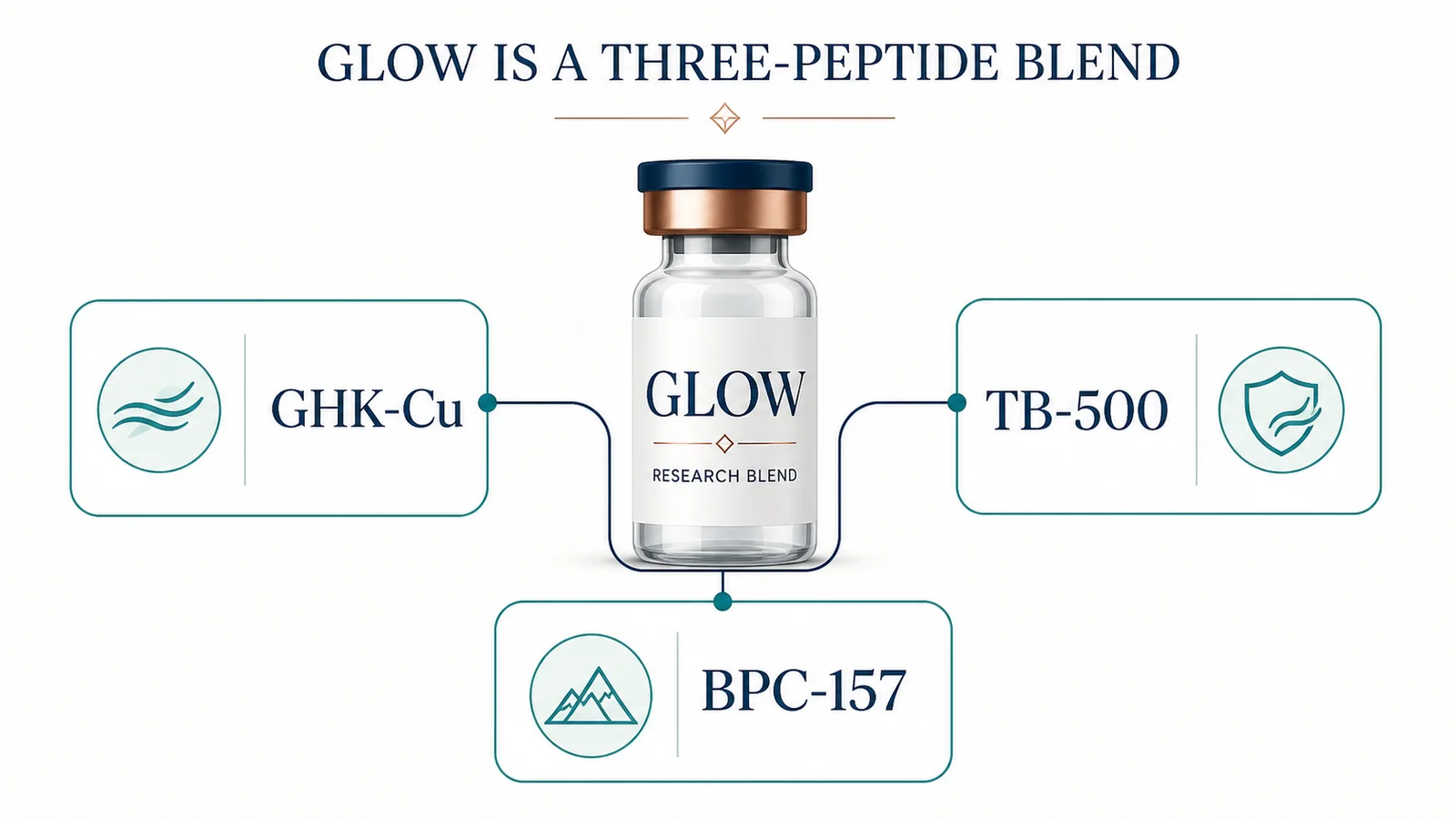
GLOW peptide is not a single peptide. It is a market name for a research blend usually made from GHK-Cu, BPC-157 and TB-500. The name is not a standardized scientific formula, so the amount of each component can differ from one supplier to another.
That definition also sets the evidence boundary. Each ingredient has its own research literature, but those component studies do not prove that the combined GLOW formula works as one clinical treatment.
What is—and is not—defined by the name GLOW?
| The name usually tells you | The name does not tell you |
|---|---|
| The blend commonly contains GHK-Cu, BPC-157 and TB-500 | The amount of each peptide |
| It is a multi-component research blend | A universal manufacturing specification |
| GHK-Cu may give the material a blue appearance | Identity, purity, sterility or clinical effectiveness |
Certiva’s GLOW-70 specification contains 50 mg GHK-Cu, 10 mg BPC-157 and 10 mg TB-500, for 70 mg total per vial. That is Certiva’s defined formula—not a rule that every product called GLOW must follow.
The three components of a GLOW blend
The useful question is not simply “What does GLOW do?” It is “What is each component, what kind of evidence exists, and has the combination itself been tested?”
| Component | What it is | Where much of the cited research sits |
|---|---|---|
| GHK-Cu | A copper-binding tripeptide | Cell, tissue and some human skin research |
| BPC-157 | A 15-amino-acid research peptide | Predominantly cell and animal research |
| TB-500 | A synthetic fragment associated with thymosin beta-4 research | Predominantly preclinical research; not interchangeable with the full protein |
GHK-Cu: the copper-binding tripeptide
GHK contains glycine, histidine and lysine. When it binds copper, the complex is called GHK-Cu and has a characteristic blue color. Laboratory studies have examined its relationship with collagen production and extracellular-matrix remodeling. Some older human skin research also exists, but it should not be used to make claims for an untested three-peptide blend.
The blue appearance is a useful physical clue, not an analytical result. It cannot confirm how much GHK-Cu is present or whether the other two components are correct. Those questions require batch-linked documentation and suitable analytical testing.
BPC-157: evidence is mostly preclinical
BPC-157 is a 15-amino-acid peptide studied in cell and animal models involving tendon cells, ligaments and other tissues. These studies help explain why the ingredient appears in research blends, but they are not equivalent to evidence of a benefit in people.
This distinction is easy to lose on commercial pages. A phrase such as “studied for tissue repair” describes a research topic. It does not show that a GLOW vial has a demonstrated therapeutic effect.
TB-500 and thymosin beta-4 are not identical terms
TB-500 is commonly described as a synthetic fragment related to thymosin beta-4, a naturally occurring 43-amino-acid peptide involved in actin biology and cell movement. Research on the full thymosin beta-4 molecule is often cited when discussing TB-500, but the two terms should not be treated as exact synonyms.
That difference is another reason to inspect the actual specification instead of relying on a memorable blend name.
Has GLOW been studied as a complete blend?
The studies most frequently used to explain GLOW examine GHK-Cu, BPC-157 or thymosin beta-4-related biology separately. We did not find a controlled human trial establishing the safety or effectiveness of the standard three-component GLOW mixture as a combined treatment.
This does not erase the component literature. It changes what can responsibly be concluded from it:
- a component study can explain why researchers are interested in that component;
- it cannot establish the effect of a different multi-peptide formula;
- adding ingredients can change stability, compatibility and analytical requirements;
- a supplier’s formulation and batch documents must be evaluated on their own.
That is the most important limitation to understand when reading a GLOW peptide page.
Why is some GLOW peptide blue?
GHK-Cu can give a GLOW blend a blue or blue-green appearance because copper is part of the complex. Shade may vary with concentration, formulation, lighting and container.
Color alone is not a pass/fail quality test. A convincing blue vial can still tell you nothing definite about peptide identity, component ratio, water content, purity or sterility. For sourcing decisions, read the label and match the lot number to the applicable documents rather than judging the vial by appearance.
GLOW vs KLOW in one paragraph
In Certiva’s formulas, KLOW-80 starts with the same GHK-Cu, BPC-157 and TB-500 trio and adds 10 mg of KPV. Because neither nickname is a universal standard, compare the printed component list and mass rather than assuming another supplier uses the same recipe. The fuller question belongs on our dedicated GLOW vs KLOW comparison, which keeps this definition page focused on GLOW itself.
What should a research buyer verify?
A usable specification should name all three components and state the mass of each, not only the total weight. It should also identify the physical form, storage conditions, lot number and available batch documents. Where a report shows purity or identity, check which component and method the result actually covers; one headline percentage should not silently stand in for every property of a multi-component blend.
For help reading those records, use our guide to peptide Certificates of Analysis and the HPLC vs mass spectrometry explanation.
Certiva supplies lyophilized peptides for laboratory research only. They are not finished medicines and are not for human consumption.
Sources and further reading
- GHK-Cu and collagen synthesis
- GHK-Cu and extracellular-matrix remodeling
- BPC-157 tendon-cell study
- BPC-157 ligament research
- Thymosin beta-4 and dermal repair research
Frequently asked questions
What is GLOW peptide?
GLOW is a market name for a research blend usually containing GHK-Cu, BPC-157 and TB-500. It is not one peptide and the name does not define a universal formula.
Is GLOW a single peptide?
No. GLOW combines multiple research peptides in one vial. Each component has its own sequence and research literature.
Is every GLOW peptide blend the same?
No. GLOW is not a standardized scientific formulation. Suppliers may use different amounts or specifications, so buyers must check the component list and mass per vial.
Why can GLOW peptide look blue?
GHK-Cu is a copper complex with a characteristic blue color. Color can be consistent with the presence of GHK-Cu, but it cannot verify identity, mass, purity or sterility.
Has the complete GLOW blend been clinically studied?
The published studies commonly cited for GLOW concern individual components, often in cells or animals. They do not establish that the three-component blend has a proven clinical effect.
What is the difference between GLOW and KLOW?
In Certiva's formulas, KLOW contains the same GHK-Cu, BPC-157 and TB-500 combination and adds KPV. Because blend names are not standardized, the specification should always be checked.
For research use only. Not for human consumption. This article is educational and makes no medical, therapeutic, or dosing claims.
← More peptide basics guides · Have a question? Start an inquiry →