
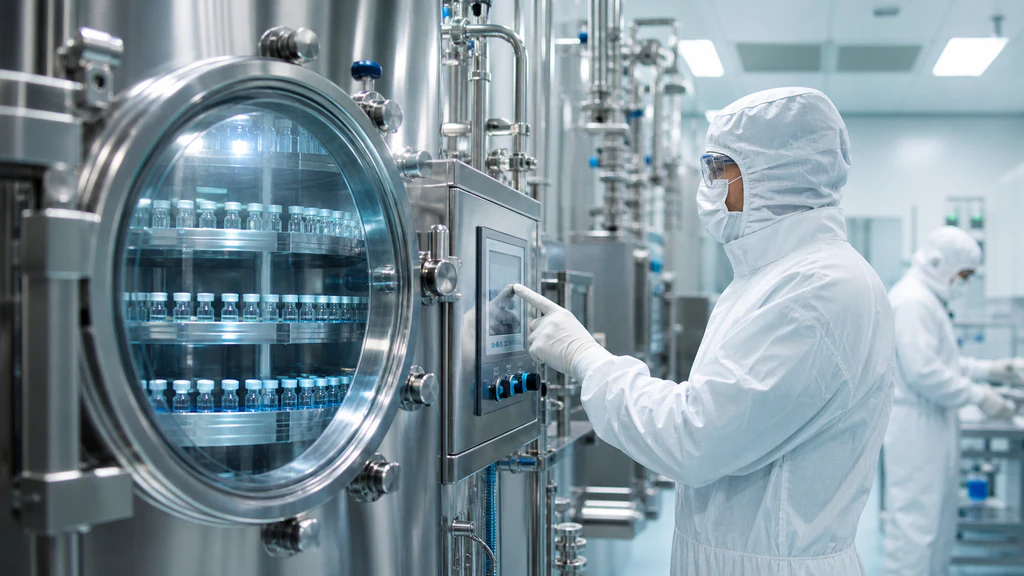
A research peptide manufacturer should be able to show where the offered material was made, which production steps it performed and how the released lot connects to its test results and packaging. A factory photograph or a COA on its own cannot establish that chain.
The practical test is to follow one real order backward: from the labeled lot to the release document, from the release document to the tested sample, and from the sample to the approved product specification and production site.
Manufacturer, supplier and testing laboratory are different roles
One company may perform several roles, but buyers should not assume that it does.
| Role | What it normally controls | What it does not prove by itself |
|---|---|---|
| Manufacturer | One or more production steps such as synthesis, purification, lyophilization or filling | That every catalog item was made at the same site |
| Supplier or distributor | Quotation, inventory, sale, packaging coordination and delivery | That it performed the manufacturing |
| Testing laboratory | Examination of the submitted sample using named methods | Who made the sample or whether the tested sample matches the delivered lot |
| Private-label company | Branding and commercial presentation | The origin or production history of the material inside the package |
This is why “direct manufacturer” is not a complete qualification result. The buyer still needs to know which steps are in-house, which are outsourced, and who owns the specification and release decision.
Start with the legal company and production site
The first check is deliberately unglamorous. Confirm the legal company name, business address, production-site address and the entity named on the quotation, invoice and bank account. If different companies appear, ask for a written explanation of their relationship.
Next, define the site scope. Does the facility perform synthesis and purification, or only filling and packaging? Is testing performed in-house, by a third party, or both? Where is inventory stored and released? A clear answer is more useful than a broad claim that everything is “made in our lab.”
Certiva identifies its manufacturing base as China and describes its production and documentation capabilities on the factory page. Qualified B2B buyers can request the applicable supporting records privately.
Trace one offered batch through six checkpoints
The best verification exercise uses a real product and lot rather than a generic company presentation.
| Checkpoint | Evidence to connect | The question it answers |
|---|---|---|
| 1. Product target | Approved name, sequence or composition, form and strength | What was the manufacturer asked to make? |
| 2. Production scope | Site and process steps associated with the batch | Which work was performed where? |
| 3. Tested sample | Sample or submission identifier linked to the lot | What material reached the laboratory? |
| 4. Analytical result | Method, result, date and reviewer | What did the named test establish? |
| 5. Released lot | COA and release status linked to the specification | Did the batch meet the agreed requirements? |
| 6. Delivered package | Lot number on vial, box and shipping records | Is this the same material the buyer received? |
A break anywhere in this chain weakens the manufacturing claim. For example, a third-party report may be genuine but still irrelevant if its sample identifier cannot be linked to the batch on the quotation.
Ask for capabilities, not an equipment list
Ranking manufacturer pages often display synthesizers, chromatography systems and lyophilizers. The images are useful context, but a long equipment list does not show whether a facility can execute a specific project consistently.
A better conversation begins with the target sequence or blend, batch size, purity and identity requirements, final format and packaging. The manufacturer can then explain the process route, purification strategy, analytical methods, expected yield constraints and development work relevant to that brief.
For custom projects, changes such as terminal modifications, counterion, fill mass or a multi-component blend may affect both production and testing. They should be reviewed before a price or minimum order is treated as final.
Review the specification before the COA
A COA reports what was found for one batch; the specification defines what the batch was expected to meet. Reviewing a headline “99% purity” result without the approved test, method and acceptance limit leaves important questions unanswered.
At minimum, the document set should let the buyer reconcile the product and lot, the identity and purity tests, the reported values, and the criteria used for release. Our guides explain how to read a peptide COA and how to match a COA to a specification.
The applicable test panel depends on the material and intended laboratory use. HPLC purity and mass-spectrometry identity answer different questions; neither automatically establishes content, sterility, endotoxin or every other quality attribute.
Verify repeatability before scaling
A strong sample can qualify a sample, not an entire future supply program. Before moving to a larger order, agree on how the proposed production lot will relate to the evaluation lot and what must remain unchanged.
Useful repeat-order controls include a stable master specification, packaging version, batch-document package and a process for notifying the buyer of material changes. The reorder quotation should also identify lead time, minimum quantity, shipping basis and what happens if the next lot does not meet the approved criteria.
The sample-to-bulk approval guide provides a simple way to connect these stages without assuming that one good vial approves future batches.
How to read certifications and GMP claims
Ask for the exact certificate, issuing body, covered legal entity, site address, scope and validity dates. A logo on a page is not enough, and a certification for one activity should not be expanded into a claim about another.
The ICH Q7 guideline describes pharmaceutical API quality systems, supplier evaluation and material controls. Research-use products should not be mislabeled as approved pharmaceutical APIs, but Q7’s record-linking principles are a useful reference when a buyer evaluates how a manufacturer controls specifications, batches and changes.
The same caution applies to contract manufacturing. The FDA guidance on quality agreements concerns drug manufacturing, not ordinary RUO supply, but it illustrates why the responsibilities of an owner and a contracted facility should be written rather than assumed.
A concise manufacturer-verification request
Instead of asking for “all factory documents,” identify the product and request the evidence that connects it:
Please confirm the legal manufacturer and production site for the quoted material, the steps performed at that site, the approved product specification, the current or representative lot documents, the testing responsibility, and how the delivered label will identify the released batch.
Add the quantity, packaging, destination and target date so the technical answer and commercial quotation describe the same project.
Certiva supports standard research vials, bulk, private-label and custom OEM inquiries. Review the factory information and then send a defined manufacturing brief if the available scope fits your project. Research peptides are supplied for laboratory research only and are not for human consumption.
Sources and further reading
- ICH Q7: Good Manufacturing Practice Guide for Active Pharmaceutical Ingredients
- FDA: Contract Manufacturing Arrangements for Drugs—Quality Agreements
Frequently asked questions
How can I verify a research peptide manufacturer?
Verify the legal company and production site, ask which steps are performed there, then trace one offered lot from its specification through production, testing, COA, label and shipment. A factory claim is useful only when those records stay connected.
What is the difference between a peptide manufacturer and supplier?
A manufacturer performs defined production steps. A supplier sells or distributes material and may source it from another company. Some businesses do both, so buyers should ask who made, tested, released and shipped the offered batch.
Does a COA prove that a seller is the manufacturer?
No. A COA can support the identity and quality review of one batch, but it does not prove who performed synthesis, purification, filling or release. Site and batch records are separate evidence.
What documents should a peptide manufacturer provide?
The appropriate package depends on the project, but it commonly includes a controlled specification, a batch-specific COA, identity and purity evidence, lot and label information, storage requirements and commercial documents that describe the same material.
Is Certiva a research peptide manufacturer?
Certiva states that it manufactures through its own facility in China and supports standard, bulk, private-label and OEM research projects. Qualified B2B buyers can request applicable company, factory, product and batch documents for review.
For research use only. Not for human consumption. This article is educational and makes no medical, therapeutic, or dosing claims.
← More sourcing & supply guides · Have a question? Start an inquiry →