

Retatrutide is not FDA approved. July 2026 topline data reported 20.8% and 22.6% average weight change at 80 weeks in two Phase 3 trials. Those are positive trial results, not an approval announcement, and they do not predict what any one person would experience.
That distinction is easy to lose in a headline. A trial can finish, a company can announce results, and a regulator can later review an application. Those are three different events. Retatrutide is at the results stage, and Lilly says it plans an FDA submission in the first quarter of 2027.
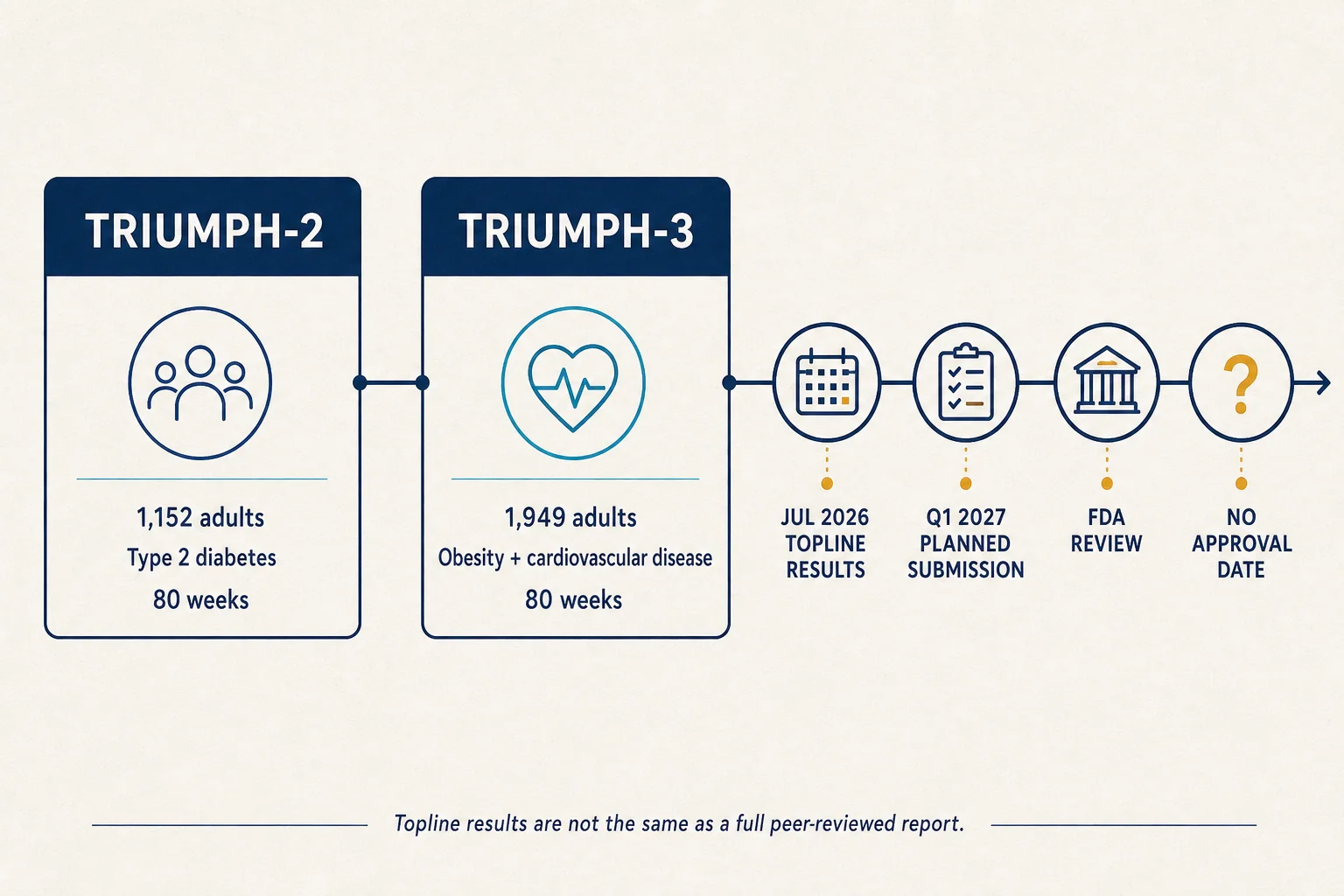
What the two headline numbers actually describe
TRIUMPH-2 and TRIUMPH-3 were both randomized Phase 3 studies, but they enrolled different populations. Comparing them side by side is more useful than treating the larger number as a universal result.
| Trial | Population | Highest-dose average at 80 weeks | Placebo average |
|---|---|---|---|
| TRIUMPH-2 | 1,152 adults with type 2 diabetes and obesity or overweight | −20.8% (−49.6 lb) | −4.0% (−9.3 lb) |
| TRIUMPH-3 | 1,949 adults with severe obesity and cardiovascular disease | −22.6% (−55.8 lb) | −3.2% (−7.7 lb) |
The 22.6% figure is likely to attract the most attention because it is larger. It is not automatically the better estimate for every population: TRIUMPH-2 enrolled people with type 2 diabetes, while TRIUMPH-3 focused on severe obesity and cardiovascular disease. These are trial averages rather than forecasts for an individual.
Both figures also come from Lilly’s July 23 topline announcement, not yet from complete peer-reviewed reports. Full publications matter because they provide the analyses, subgroup results, missing-data handling and detailed safety tables that a press release cannot contain.
Why the average is not a promise
Clinical-trial percentages describe a group under a written protocol. They do not say that everyone lost the same amount, that the change was all body fat, or that the result will carry over to people outside the enrollment criteria. An average can sit in the middle of very different individual outcomes.
The word estimand also matters. It describes the question a statistical analysis is designed to answer. A treatment-regimen estimate can include outcomes after a participant stops treatment or uses another intervention. An efficacy estimate asks a more treatment-adherent question. Both can be useful, but they are not the same number and should be labeled when compared. Lilly’s July announcement highlighted the efficacy-estimand figures above; a complete publication should make it easier to see the companion analyses and how missing data were handled.
The safest way to read any retatrutide result is to keep five labels attached: trial, population, dose, week, and estimand. Removing those labels turns a study result into an advertisement.
What happened in TRIUMPH-2?
TRIUMPH-2 evaluated retatrutide in adults who had type 2 diabetes and obesity or overweight. Lilly reported results for three target doses. Average body-weight change at week 80 was 12.7% for 4 mg, 19.1% for 9 mg, and 20.8% for 12 mg, compared with 4.0% for placebo. The sponsor also reported average A1C reductions of up to 1.6 percentage points.
The study population is important context. People with type 2 diabetes can respond differently in weight-management trials, so TRIUMPH-2 should not be casually compared with a study that excluded diabetes. The trial’s ClinicalTrials.gov record identifies it as NCT05929079 and describes the study design, endpoints, and enrollment criteria.
What happened in TRIUMPH-3?
TRIUMPH-3 enrolled adults with severe obesity and established cardiovascular disease, including participants both with and without type 2 diabetes. Lilly reported an average body-weight change at week 80 of 21.6% for the 9 mg group and 22.6% for the 12 mg group, compared with 3.2% for placebo.
The company also reported changes in waist circumference and several cardiovascular risk markers. Those secondary findings are interesting, but they should not be read as proof that retatrutide prevents cardiovascular events. The event analysis reported in the announcement had a confidence interval that crossed 1, and the full evidence will require more detailed review. The ClinicalTrials.gov record for this study is NCT05882045.
More specifically, Lilly reported a hazard ratio of 0.82 for its five-component cardiovascular event measure and 1.12 for the more familiar three-component measure. Both confidence intervals crossed 1. In plain English, the available event data were too imprecise to show a clear reduction or increase. Changes in waist size, blood pressure, or laboratory markers can be encouraging without proving fewer heart attacks or strokes.
Why retatrutide is described as a triple agonist
Retatrutide is one peptide designed to activate the GIP, GLP-1, and glucagon receptor systems. That three-receptor design is why it is commonly called a “triple agonist.” By comparison, semaglutide targets the GLP-1 receptor, while tirzepatide targets GIP and GLP-1 receptors.
The receptor count is an easy way to describe the molecules, but it is not a ranking system. More targets do not automatically mean a better medicine. Dose, tolerability, study population, clinical outcomes, and regulatory review all matter. Our retatrutide versus tirzepatide comparison explains those differences without treating separate trials as a head-to-head test.
What the safety report does—and does not—tell us
In both trials, the most commonly reported adverse events were gastrointestinal, including diarrhea, nausea, constipation, decreased appetite, and vomiting. Lilly described most of these events as mild to moderate and said most resolved during treatment.
The sponsor’s release provided enough detail to show why dose and population still matter:
| Trial | Selected reported adverse-event rates | Discontinuation due to adverse events |
|---|---|---|
| TRIUMPH-2 | Diarrhea: 27.4% to 33.6% across retatrutide groups vs 13.2% placebo; nausea: 13.7% to 28.0% vs 8.0% | 3.8% to 11.6% vs 4.9% placebo |
| TRIUMPH-3 | Diarrhea: 24.4% to 30.1% across retatrutide groups vs 8.7% placebo; nausea: 21.7% to 22.4% vs 5.8% | 9.8% to 13.5% vs 4.8% placebo |
These ranges are a readable summary, not a substitute for a full safety table. They also explain why the highest weight-change number cannot be separated from tolerability. If more people stop a dose because of adverse events, that belongs in the benefit-risk discussion.
That summary is useful, but it is not the complete safety picture. Topline results do not replace full adverse-event tables, discontinuation data, subgroup analyses, or regulatory review. Anyone evaluating the clinical evidence should distinguish the sponsor’s early summary from the eventual study publication and FDA assessment. Our retatrutide side-effects article follows the same evidence-first approach.
What the July release still does not answer
The announcement is detailed for a press release, but it cannot show the full shape of the data. We know the group averages. We do not yet have a complete view of how many participants had little change, how many reached different weight-loss thresholds at every dose, or how outcomes varied across clinically important subgroups. Those distributions help a clinician understand the chance of different outcomes; one mean percentage cannot do that job.
We also need the full treatment-regimen analyses. The headline efficacy estimand asks what the treatment effect would look like if participants remained on the study intervention, allowing dose interruptions and modifications, without prohibited weight-management treatment. That is a valid trial question. A treatment-regimen view, which better preserves the effect of stopping treatment or using another intervention, answers a different and often more practical question. Neither should be hidden behind the other.
Body composition deserves care too. A change in total body weight does not tell us by itself how much came from fat mass, lean mass, or fluid. That question matters in obesity care, especially for older adults and people with other chronic conditions. Until the relevant analyses are public, the responsible phrase is “body-weight change,” not a more specific claim about fat or muscle.
Finally, 80 weeks is long enough to be meaningful but not long enough to answer every question about years of treatment, rare adverse events, weight maintenance, or what happens after discontinuation. Regulators can review information beyond what appears in a publication, and post-approval monitoring can continue if a medicine is later approved. Positive Phase 3 results therefore reduce uncertainty; they do not remove it.
This is why a good retatrutide update page should change as evidence changes. The date at the top is part of the answer. A July 2026 topline summary, a future conference presentation, a peer-reviewed paper, a submitted application, and an FDA decision will each support a different level of certainty.
Is retatrutide FDA approved, and when could that change?
As of August 27, 2026, retatrutide is not FDA approved. The FDA explicitly lists retatrutide among unapproved GLP-1-related substances and says it has not been found safe and effective for any condition. Lilly’s stated plan is to submit a Biologics License Application (BLA) in the first quarter of 2027.
There is no responsible way to turn that plan into an approval date. After a submission, the FDA must decide whether to accept the application and then review the clinical, manufacturing, and labeling package. The agency could approve it, request more information, or decline approval. A Phase 3 result, even a positive one, does not predetermine that decision.
Readers should also be cautious with products marketed online as compounded retatrutide or as “research use only” while being promoted for personal use. FDA says retatrutide cannot currently be used in compounding under federal law and has warned companies about products falsely presented as research materials. Certiva supplies analytical reference materials only for legitimate laboratory and institutional research, not for human use, compounding, or self-administration.
What happens next in the retatrutide approval timeline?
There are at least four separate milestones to watch:
- Detailed presentation or publication. This should reveal fuller statistical, subgroup, discontinuation, and safety information.
- A completed application. Lilly has said it plans a U.S. submission in the first quarter of 2027. A plan is not a filing.
- FDA acceptance and review. The agency first decides whether the application is complete enough to review. It then evaluates clinical evidence, manufacturing, labeling, and benefit-risk questions.
- A decision. Only an FDA approval would create approved U.S. labeling. There is currently no official retatrutide approval date.
This sequence is less exciting than a viral post, but it is the most reliable way to answer “when will retatrutide be available?” Until a regulator makes a decision, timelines remain estimates and online products do not become approved medicine by using the same molecule name.
How does this update compare with earlier retatrutide research?
The earlier Phase 2 obesity study established the main signal that pushed retatrutide into larger trials. The 2026 news matters because two Phase 3 studies now showed substantial average weight change in populations with type 2 diabetes or cardiovascular disease. Larger studies can better describe common adverse events and performance across a broader group, but they do not erase the need for full review.
It is also too early to call retatrutide the winner against semaglutide or tirzepatide. The cleanest comparison comes from a randomized head-to-head trial, not from placing percentages from different protocols side by side. Our retatrutide versus semaglutide guide and retatrutide versus tirzepatide guide keep the trial populations and status differences visible.
The verb in the next headline will matter
The next update may concern a publication, a regulatory submission, acceptance of that application, or an FDA decision. Those milestones are not interchangeable. Before sharing the headline, check who issued it, which population was studied and whether the language says “submitted,” “accepted” or “approved.” One verb can change the meaning of the entire story.
For laboratory teams evaluating a retatrutide reference standard, clinical headlines are separate from batch quality. The relevant questions are whether the material is correctly identified, whether the lot matches its documentation, and which analytical tests support the stated specification. Our guide to reading a peptide COA shows how to check that evidence.
What the 2026 Phase 3 evidence adds
The July 2026 results add two positive Phase 3 studies to retatrutide’s development program. Lilly reported average body-weight changes of 20.8% in TRIUMPH-2 and 22.6% in TRIUMPH-3 at the highest studied dose after 80 weeks. Those figures deserve attention, but retatrutide is still investigational, the detailed evidence is still developing, and there is no FDA approval date.
Clinical news and analytical procurement are separate questions. Laboratories that need a retatrutide reference material can review the quality and COA process or contact Certiva for the available specification and current-lot documentation. The material is for legitimate laboratory research, not human use.
Sources and further reading
- Eli Lilly: TRIUMPH-2 and TRIUMPH-3 topline results, July 23, 2026
- ClinicalTrials.gov: TRIUMPH-2, NCT05929079
- ClinicalTrials.gov: TRIUMPH-3, NCT05882045
- New England Journal of Medicine: retatrutide Phase 2 obesity trial
- FDA: concerns with unapproved GLP-1 drugs used for weight loss
Frequently asked questions
What are the latest retatrutide Phase 3 results?
Retatrutide is not FDA approved. July 2026 topline data reported 20.8% and 22.6% average weight change at 80 weeks in two Phase 3 trials.
Is retatrutide FDA approved in 2026?
No. Retatrutide remains investigational and is not FDA approved. Lilly has said it plans to submit an application to the FDA in the first quarter of 2027.
What is the retatrutide approval timeline?
There is no official approval date. Lilly plans an FDA submission in the first quarter of 2027, after which the agency would decide whether to accept and approve the application. Trial completion and an FDA submission are not approvals.
What did TRIUMPH-2 study?
TRIUMPH-2 studied adults with type 2 diabetes who also had obesity or overweight. At 80 weeks, the 12 mg group had an average body-weight change of 20.8%, compared with 4.0% for placebo.
What did TRIUMPH-3 study?
TRIUMPH-3 studied adults with severe obesity and established cardiovascular disease, with or without type 2 diabetes. At 80 weeks, the 12 mg group had an average body-weight change of 22.6%, compared with 3.2% for placebo.
Are the July 2026 results peer reviewed?
The figures discussed here are topline results announced by the trial sponsor. A press release is not the same as a complete peer-reviewed publication, so fuller interpretation should wait for detailed study data.
For research use only. Not for human consumption. This article is educational and makes no medical, therapeutic, or dosing claims.
← More gLP-1 & weight management guides · Have a question? Start an inquiry →