
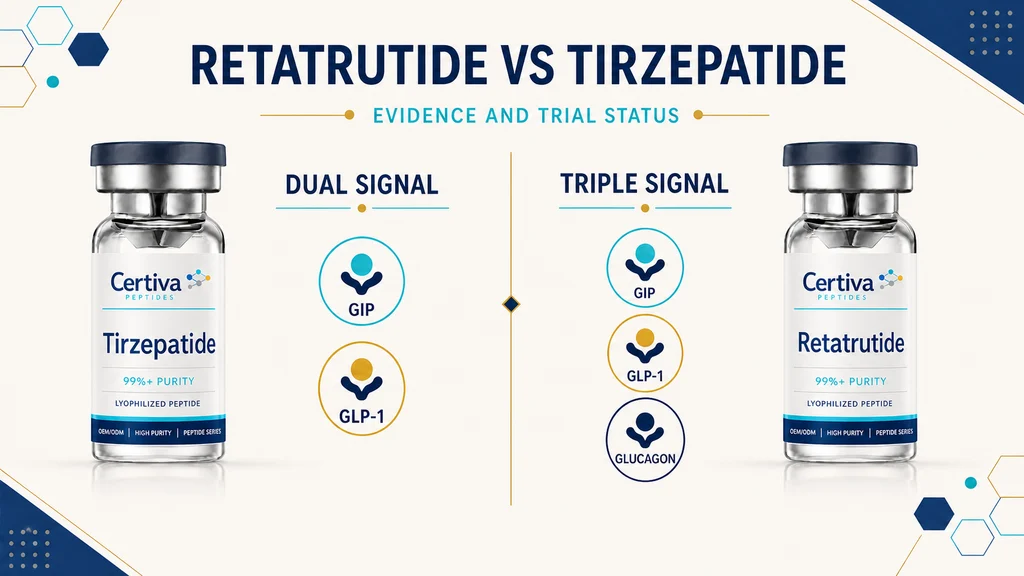
Retatrutide and tirzepatide are related, but they are not interchangeable. Tirzepatide is a dual GIP/GLP-1 receptor agonist with FDA-approved uses. Retatrutide adds glucagon receptor activity and remains investigational.
Retatrutide has produced the larger headline weight-loss average in a separate Phase 3 trial. That does not yet make it the proven winner. The first direct Phase 3 comparison, TRIUMPH-5, is still underway and has no posted results.
Retatrutide vs tirzepatide at a glance
| Question | Tirzepatide | Retatrutide |
|---|---|---|
| Receptor activity | GIP + GLP-1 | GIP + GLP-1 + glucagon |
| Development status | Active ingredient in FDA-approved medicines | Investigational; not FDA approved |
| Frequently cited obesity result | 20.9% mean change at 72 weeks in the 15 mg SURMOUNT-1 group | 28.3% mean change at 80 weeks in the 12 mg TRIUMPH-1 efficacy analysis |
| Can those figures be treated as head-to-head? | No | No |
| Direct comparison | TRIUMPH-5, no results posted as of August 12, 2026 | TRIUMPH-5, no results posted as of August 12, 2026 |
The status difference matters more than the receptor count alone. One molecule has approved labeling and a longer clinical record; the other has promising late-stage results that regulators have not yet evaluated for approval.
Why the headline percentages do not identify a winner
It is tempting to place 28.3% beside 20.9% and subtract. That calculation looks precise, but it ignores how clinical trials work.
The 20.9% tirzepatide figure comes from the 15 mg group in SURMOUNT-1 at 72 weeks. The 28.3% retatrutide figure comes from the 12 mg group in TRIUMPH-1 at 80 weeks under the efficacy estimand—an analysis of the effect if participants adhered to treatment. Lilly also reported 25.0% for the same retatrutide group under the treatment-regimen estimand, which includes the effect of discontinuation regardless of adherence.
Those trials enrolled different people, ran for different lengths of time and used separate protocols and statistical analyses. A larger number in one study can be scientifically interesting without proving superiority over a drug tested in another study.
This distinction is easy to lose in summaries. Whenever a comparison article presents a single percentage, check the trial, population, week, dose and estimand attached to it.
How their mechanisms differ
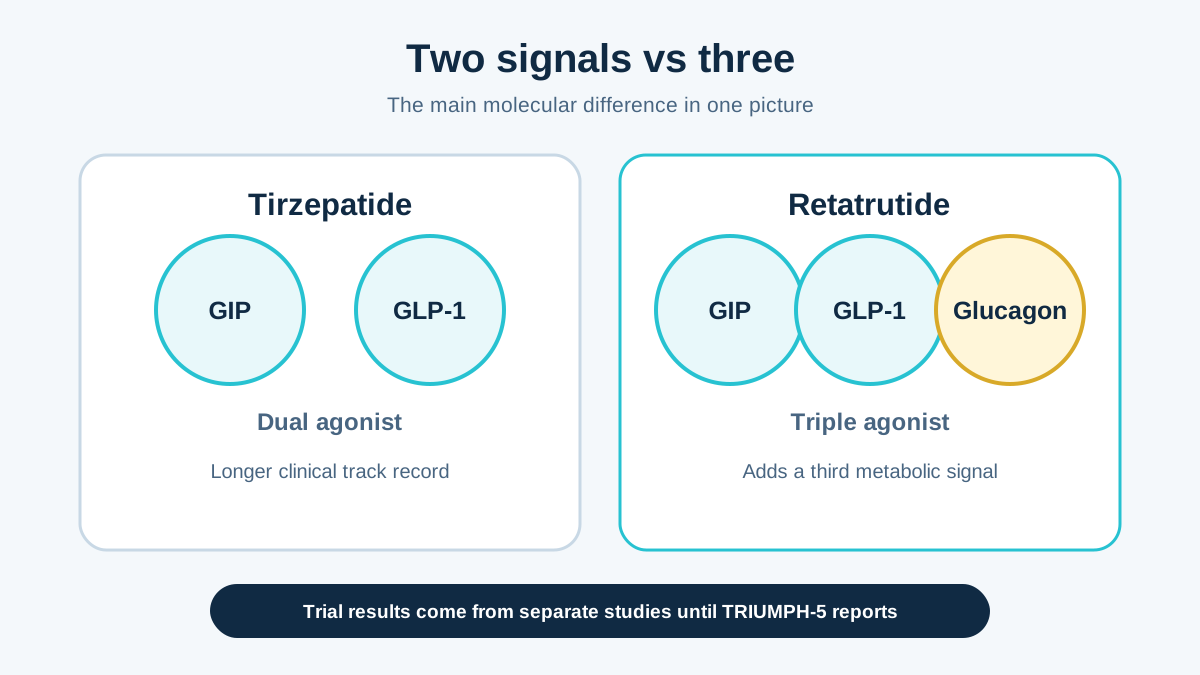
Tirzepatide activates glucose-dependent insulinotropic polypeptide (GIP) and glucagon-like peptide-1 (GLP-1) receptors. Retatrutide activates those pathways and the glucagon receptor.
The third signal is one reason retatrutide is being studied for effects on energy balance and metabolic disease. It is not a shortcut for predicting the size of an effect or an individual’s response. Dose escalation, exposure, trial population and tolerability all influence the result.
What the major obesity trials actually reported
| Study | Population and design | Main figure commonly compared | Important context |
|---|---|---|---|
| SURMOUNT-1 | Adults with obesity or overweight without diabetes; randomized Phase 3 trial | 20.9% mean change at 72 weeks for tirzepatide 15 mg | Peer-reviewed; the 10 mg and 5 mg groups averaged 19.5% and 15.0% |
| TRIUMPH-1 | Adults with obesity or overweight without diabetes; Phase 3 trial | 28.3% mean change at 80 weeks for retatrutide 12 mg under the efficacy estimand | Lilly topline release; the treatment-regimen estimate was 25.0% |
| TRIUMPH-5 | Adults with obesity; randomized, double-blind Phase 3 direct comparison | No results posted | About 800 participants; 80-week primary endpoint |
TRIUMPH-1 also included a prespecified extension for participants who began with a BMI of at least 35 and completed and tolerated treatment. Lilly reported 30.3% at 104 weeks in that subset. It should not be presented as though it were the result for every participant.
For a closer look at the 2026 program, including which figures are efficacy estimates and which are treatment-regimen estimates, see our Retatrutide Phase 3 results guide.
What TRIUMPH-5 should clarify
TRIUMPH-5 is the study designed to answer the comparison more directly. It randomizes adults with obesity to retatrutide or tirzepatide under the same protocol and measures percentage change in body weight at week 80.
The ClinicalTrials.gov record was verified in July 2026 as active, not recruiting. It lists an estimated primary completion in November 2026 and estimated study completion in December 2026. An estimated completion date is not a publication date, and the registry currently shows no results.
Until results are released and the analysis can be inspected, claims that either molecule “wins” the direct comparison are premature.
Approval and access are not the same
Tirzepatide is the active ingredient in FDA-approved prescription medicines. The FDA approved Zepbound for chronic weight management in adults meeting the labeled criteria in 2023, and its prescribing information describes indications, contraindications, warnings and adverse reactions.
Retatrutide is not FDA approved. Lilly states that it is legally available only to participants in its clinical trials. Products marketed online as retatrutide are not Lilly’s approved finished medicine, because no such approved medicine exists.
This page discusses published evidence and research-reference specifications. It does not recommend either molecule for personal use or replace advice from a licensed clinician.
What is known about tolerability
Gastrointestinal events—including nausea, diarrhea, constipation and vomiting—were common in the separate trial programs, particularly during dose escalation. TRIUMPH-1 also reported dysesthesia, described as altered skin sensation, more often with retatrutide than placebo.
Raw percentages from separate studies should be handled with the same caution as efficacy figures. Different dose schedules, definitions, follow-up and populations can change event rates. The approved tirzepatide label is the appropriate source for its established warnings and contraindications; retatrutide does not yet have an approved label.
What this comparison can—and cannot—answer
The evidence supports three conclusions today:
- The molecules activate different combinations of receptors.
- Retatrutide has the larger separately reported Phase 3 headline average.
- Tirzepatide has FDA-approved uses and a substantially more established clinical record.
It cannot yet tell us that retatrutide is clinically superior to tirzepatide. That requires the completed head-to-head evidence, full analysis and regulatory review.
For laboratory buyers, clinical percentages also do not replace batch-specific documentation. Compare the exact specification, lot-linked COA and intended analytical use separately from claims about finished medicines. Our peptide COA guide explains that document check.
Research peptides are supplied for laboratory research use only and are not for human consumption.
Sources and further reading
- Lilly: TRIUMPH-1 Phase 3 topline results, May 21, 2026
- New England Journal of Medicine: SURMOUNT-1 tirzepatide trial
- ClinicalTrials.gov: TRIUMPH-5, NCT06662383
- FDA: Zepbound approval for chronic weight management
Frequently asked questions
What is the main difference between retatrutide and tirzepatide?
Tirzepatide activates GIP and GLP-1 receptors. Retatrutide activates those two receptors and the glucagon receptor, making it a triple agonist rather than a dual agonist.
Which caused more weight loss, retatrutide or tirzepatide?
Retatrutide produced the larger headline average in a separate trial, but that is not proof that it outperforms tirzepatide. TRIUMPH-1 and SURMOUNT-1 differed in duration, participants and analysis, so a direct comparison must wait for head-to-head data.
Is retatrutide FDA approved?
No. Retatrutide remains investigational. Tirzepatide is the active ingredient in FDA-approved prescription medicines, including Zepbound for chronic weight management.
Is there a head-to-head retatrutide vs tirzepatide trial?
Yes. TRIUMPH-5 is an 800-participant Phase 3 trial comparing the two molecules over 80 weeks. As of August 2026 it is active but no longer recruiting, with primary completion estimated for November 2026 and study completion for December 2026. No results have been posted.
Do retatrutide and tirzepatide have similar side effects?
Gastrointestinal events such as nausea, diarrhea, constipation and vomiting were common in their respective trials. Rates cannot be compared reliably until both are studied under the same protocol.
For research use only. Not for human consumption. This article is educational and makes no medical, therapeutic, or dosing claims.
← More gLP-1 & weight management guides · Have a question? Start an inquiry →